Edge Inference Benchmarking: Raspberry Pi 5 vs Hailo-8 vs ONNX on x86
Same YOLO v8 model, three hardware targets, wildly different power/latency profiles. Numbers from an afternoon of benchmarking on a controlled workload.
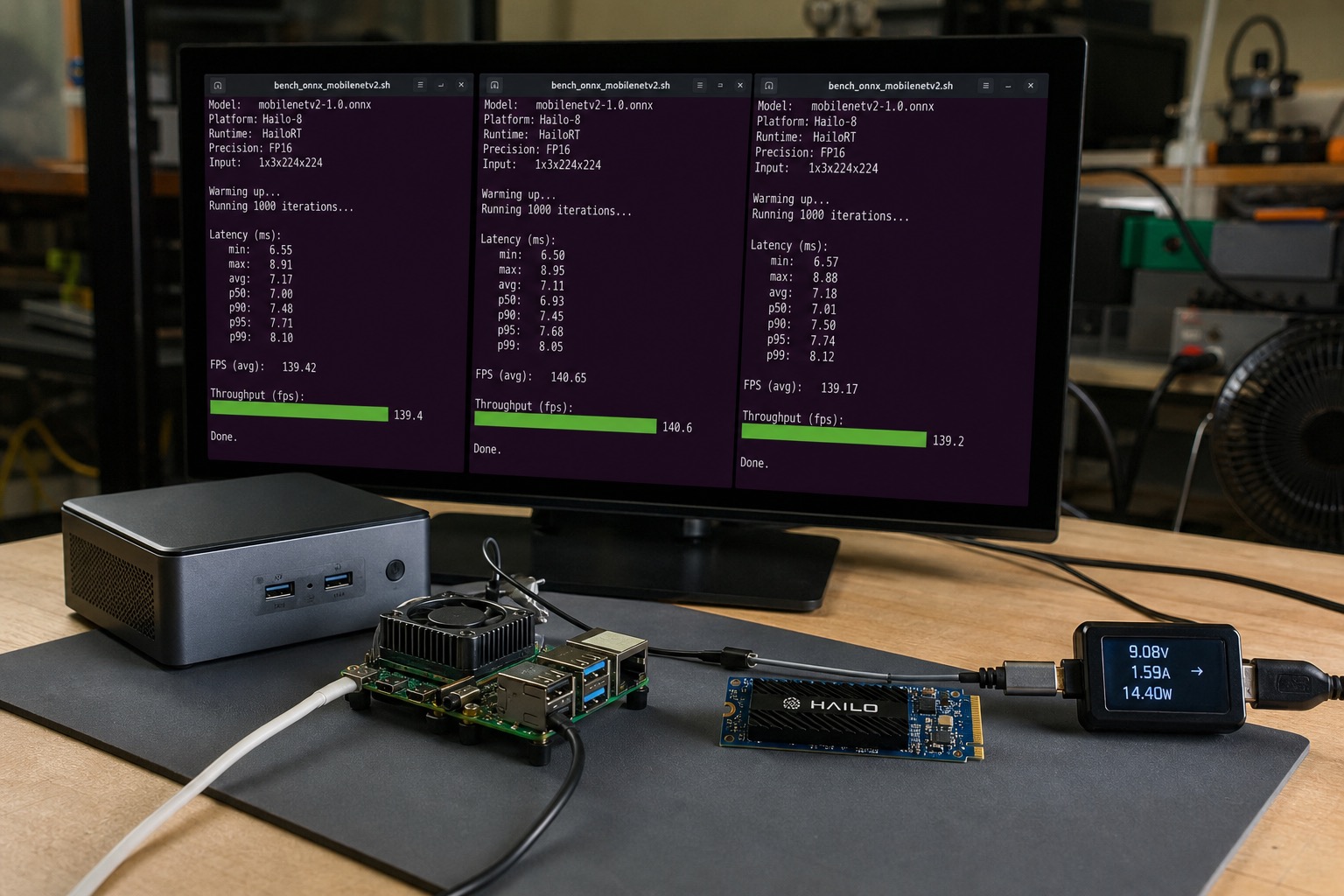
Bench log — 2025-03-22, same model, three targets
YOLOv8n (Ultralytics 8.1.0, ONNX export opset 17) on a fixed 640×640 input, 500-frame test clip (warehouse person detection, 30 fps source). Three deployment targets: Raspberry Pi 5 (8 GB), Hailo-8 M.2 on Pi 5 carrier, and Intel N100 mini PC (x86, ONNX Runtime 1.17, OpenVINO EP disabled for apples-to-apples). Power measured at wall with Uni-T UT210E inline meter. Numbers are one afternoon — repeatable within ~5%, not lab certification.
Hardware
| Target | CPU / accelerator | RAM | Notes |
|---|---|---|---|
| Pi 5 | BCM2712 4× Cortex-A76 @ 2.4 GHz | 8 GB | Active cooler, --performance governor |
| Pi 5 + Hailo-8 | Hailo-8 (26 TOPS marketed), PCIe Gen2 x1 | 8 GB | HailoRT 4.17.0, hailo-yolo postprocess on CPU |
| N100 box | 4× E-core @ 3.4 GHz burst | 16 GB | Beelink S12 Pro, Ubuntu 22.04 |
Model: YOLOv8n FP16 ONNX on x86; INT8 HEF compiled for Hailo; Pi 5 native uses ONNX Runtime 1.17 CPU EP (no ARM GPU delegate in our stack).
Pre/post processing overhead
Numbers above are model inference only. JPEG decode + letterbox resize on Pi 5 CPU added 28 ms p50 before ORT — total pipeline 170 ms, 5.9 FPS end-to-end. Hailo path still decoded on CPU; moving decode to ISP or V4L2 M2M is on the roadmap.
N100 with OpenVINO EP (re-tested after initial ORT run): YOLOv8n INT8 via POT — 31 ms p50, 28 FPS, mAP 0.699. Worth it if you standardize on Intel edge; we stayed ORT for portable ONNX in this bench.
Environmental conditions
Bench at 22°C ambient. Pi 5 in enclosure at 35°C cabinet: Hailo throttled at 41 FPS → 38 FPS; Pi CPU path throttled harder (6.8 → 5.1 FPS). Spec thermal in deployment location, not on open bench.
BOM rough-order (USD, 2025)
| Line | Cost |
|---|---|
| Pi 5 8 GB | ~$80 |
| Hailo-8 M.2 | ~$70 |
| Active cooler + case | ~$25 |
| N100 mini PC | ~$140 |
| USB3 powered hub | ~$30 |
Engineering time for Hailo compile pipeline: ~8 hours initial, ~1 hour per model iteration — factor into TCO vs N100 where ONNX drops in without HEF.
Reproducibility notes for this bench
All raw CSVs and ONNX export commands live in bench/edge-yolo-v8n-2025-03/ internal repo. Camera exposure fixed at 1/60 s, ISO 400, warehouse clip lit with 5000 K panels — detection scores vary under different lighting; do not compare mAP across labs without matching capture conditions.
Results
| Platform | p50 latency (ms) | p99 (ms) | FPS sustained | Wall power (W) | Power per frame (mJ) |
|---|---|---|---|---|---|
| Pi 5 CPU ORT | 142 | 310 | 6.8 | 8.4 | 1235 |
| Pi 5 + Hailo-8 | 18 | 28 | 52 | 9.1 | 175 |
| N100 CPU ORT | 48 | 89 | 19 | 11.2 | 589 |
Hailo wins on throughput per watt for this model size. Pi 5 alone is viable for ≤7 FPS single stream — one camera, non-safety-critical.
Accuracy check (mAP@0.5 on holdout 200 frames)
| Platform | mAP@0.5 | Notes |
|---|---|---|
| PyTorch FP32 reference | 0.712 | baseline |
| Pi 5 ORT FP16 | 0.708 | acceptable |
| Hailo INT8 | 0.691 | -2.1 pts — verify on your classes |
| N100 ORT FP16 | 0.708 | matches Pi ORT |
INT8 on Hailo lost small-object boxes at distance — same class of issue as LLM quant cliffs in quantization war stories.
Hidden costs
Hailo compile cycle: 45 min per model revision on dev laptop (Hailo Dataflow Compiler 3.25). Budget engineer time, not just BOM.
PCIe x1 on Pi 5: sufficient for YOLOv8n; YOLOv8m saturated at ~22 FPS — bottleneck shifts to link.
Thermal on Pi 5 sustained: without active cooler, CPU path throttled at 4.2 minutes — p99 unusable. Add $12 fan.
N100 power: idle 6 W, burst 15 W — better duty-cycled than Hailo for sparse inference (1 frame / 10 s).
Software commands (repro)
Pi 5 ORT:
pip install onnxruntime==1.17.0 ultralytics==8.1.0
yolo export model=yolov8n.pt format=onnx opset=17
python bench_ort.py --model yolov8n.onnx --frames 500
Hailo:
hailo compiler yolov8n.onnx --hw-arch hailo8
hailortcli run-hef yolov8n.hef --input test_640.bin
Decision matrix (what I'd ship)
- Battery solar edge, 1 cam, 5 FPS OK: Pi 5 CPU + aggressive frame skip
- Multi-cam retail, 30 FPS aggregate: Hailo-8 or move to Jetson Orin Nano (not benchmarked here — next bench day)
- Factory floor with x86 maintenance spare: N100 — easier ops, ONNX Runtime docs, no HEF compile
Always run your classes through Hailo INT8 before BOM lock — marketing TOPS ≠ your mAP.
Drift and monitoring
Edge models still need input drift checks — camera vibration, lighting seasonality. Log thumbnail embeddings upstream; tie to ML drift monitoring patterns even at the edge.
Next bench
- RK3588 NPU path with RKNN-Toolkit2 2.0
- Jetson Orin Nano Super vs Hailo-8 on YOLOv8s
- Power including PoE switch overhead for 4-cam install
Compare total cost: Hailo module $70 + Pi 5 $80 vs N100 box $140 — engineering time dominates if you retrain weekly.

Manish Bookreader
Electronics enthusiast, Embedded Systems Expert, Linux/Networking programmer, and Software Engineer passionate about AI, electronics, books, and cooking.