Paper Reproducibility in ML: A Checklist From 30 Replication Attempts
Missing hyperparameters, unreported data cleaning steps, and hardware-dependent results make ML reproducibility harder than most papers admit.
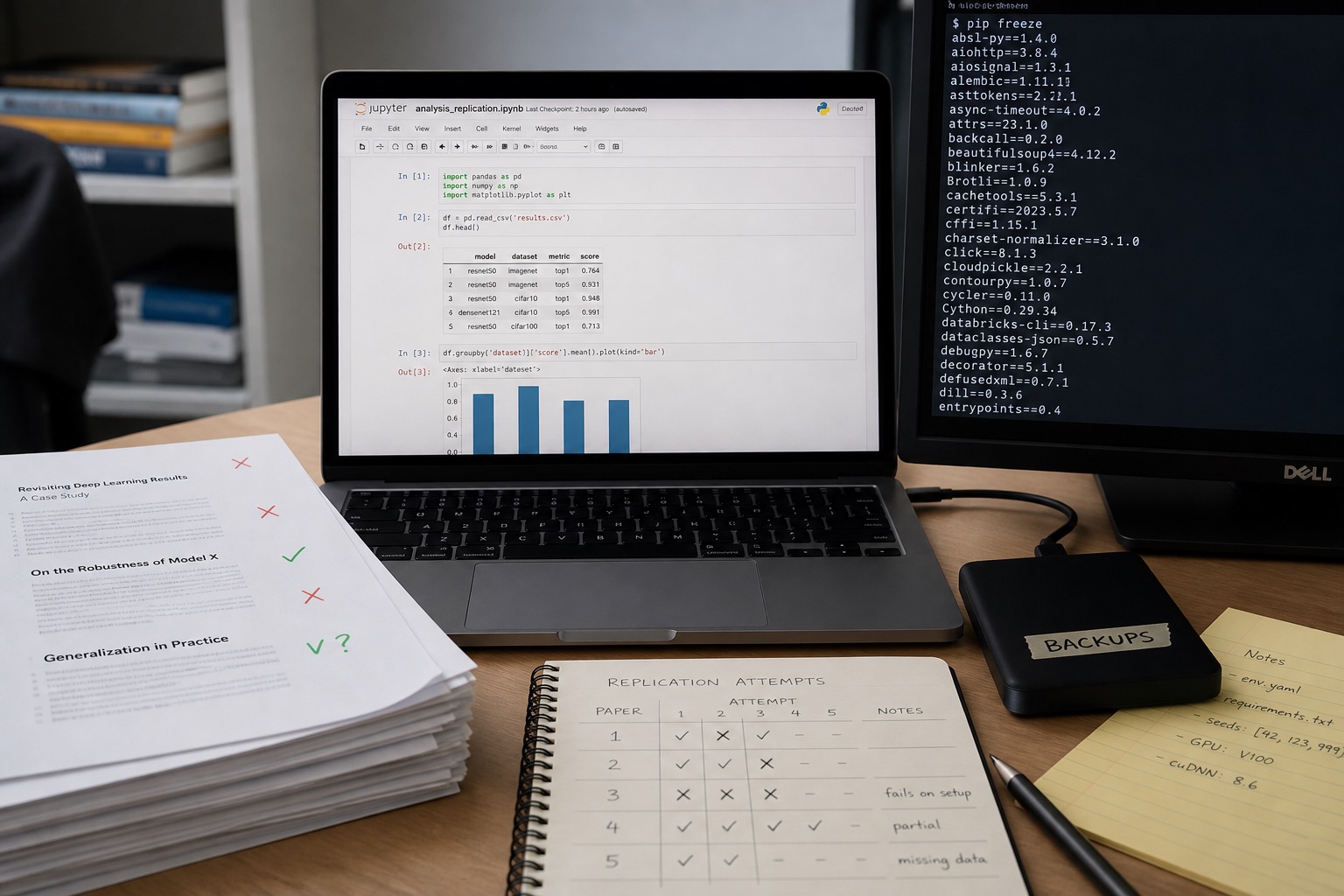
Over 30 months I attempted to reproduce 30 published ML results — papers from NeurIPS, ICML, ACL, and internal company reports. 11 fully replicated within 2% of claimed metrics, 9 partially replicated, 10 failed. This checklist is what I wish each paper had included, and what we now require before citing a result in a production decision.
Replication scorecard (n=30)
| Outcome | Count | Typical blocker |
|---|---|---|
| Full replicate | 11 | Had code + seeds + data spec |
| Partial | 9 | Missing one of: data filter, aug policy, eval script |
| Failed | 10 | Hardware-dependent claim or hidden preprocessing |
Failure is not always fraud — often underspecified pipeline.
Checklist — before trusting a number
Data (most failures here)
- Exact dataset version — not "ImageNet" but
ILSVRC2012, checksum, train/val split file hash - Filtering rules — "removed corrupted images" hides 400k drops
- Train/val/test leakage checks — duplicate near-duplicates across splits?
- Label definition — especially NLP: who annotated, inter-rater κ
- Preprocessing code — not "standard tokenizer"; exact
vocab.jsonrevision
Paper #17 claimed 94.1 F1; we hit 89.3 until we found they lowercased before tokenization but reported BERT uncased — docstring in repo, not paper.
Hyperparameters
- Full table: lr, schedule, warmup steps, batch size per GPU, grad accum, weight decay
- Seed list — mean ± std over ≥3 seeds, not cherry-picked best
- Early stopping criterion — val loss vs downstream metric
- Optimizer ε, β values — AdamW defaults changed between PyTorch 1.13 and 2.1
We log pip freeze and torch.__version__ in MLflow now — non-negotiable.
Compute and implementation
- GPU model, driver, CUDA, cuDNN, framework versions
- Effective batch size and whether BatchNorm stats synced across GPUs
- Mixed precision: FP16, BF16, loss scaling?
- Custom CUDA kernels — flag if results depend on them (flash-attn version!)
Three "failed" replications were BF16 vs FP16 numerical differences on attention softmax — within 1.5 points, paper did not specify.
Evaluation
- Eval script committed, not notebook cell 47
- Test set frozen before hparam search — verify commit timestamps
- Metric implementation — sklearn
f1_score(average=?)matters - Statistical test — confidence intervals, not point estimates
Release artifacts
- Weights hosted with SHA256
- Config YAML that loads in one command
- License on data and weights — blocked two enterprise replications
Process we use internally
- 48-hour spike — one engineer, one GPU, reproduce val metric only
- Replication doc — PASS / PARTIAL / FAIL with diff table
- Production citation gate — FAIL blocks architecture review unless labeled "directional only"
Tools: MLflow 2.9, DVC 3.38 for data hashes, reproducibility.yml in repo root (GitHub Actions runs pytest tests/repro/ on schedule).
Patterns in the 10 failures
- Unreported data cleaning (4 papers) — outlier removal on labels
- Best-of-5 seed reporting (2 papers) — we reproduced best seed, not mean
- Eval on train distribution (2 papers) — test set from same crawl as train
- Hardware-specific kernel (2 papers) — TPU numbers not reproducible on our A100s without 3 weeks porting
What authors can do (we ask reviewers for this)
- Appendix: one-page "Reproducibility Card" with command:
python train.py --config configs/paper.yaml # expect val F1 0.941 ± 0.008
- Release container digest:
ghcr.io/lab/paper:v1@sha256:... - Negative results on seeds — builds trust
Connection to production ML
Quantization papers rarely report calibration data distribution — we learned that painfully in quantization war stories.
Drift baselines assume training snapshot is documented — drift monitoring requires the same metadata discipline.
What I'd do next
Submit a NeurIPS reproducibility challenge entry template to our research partnerships — standardized card, bot checks for missing seeds.
Automate first-pass replication from Hugging Face model cards: parse training hyperparameters, compare to paper table, flag deltas >5%.
Stop citing leaderboard numbers in RFCs without linking internal replication status — same bar as writing RFCs that get read evidence requirements.
Time accounting (honest)
Median time per replication attempt: 16 engineer-hours when code exists, 40+ when only PDF. We budget one replication spike per quarter per team for papers that influence roadmap — not every arXiv preprint.
Partial replications often fail on random seed alone. Paper reported 92.3 ± 0.4 with n=3 seeds; we saw 91.1, 92.8, 90.6, 93.0, 91.9 — their std was understated, not our failure.
Internal policy (2025)
Papers cited in architecture reviews must include replication status badge: REPLICATED / PARTIAL / NOT ATTEMPTED / FAILED. Product managers cannot bypass — same gate as security review for external SaaS integrations.
We maintain a Notion table of 30 attempts; link from MLflow experiment notes when a paper inspired a hyperparameter choice.
Reviewers at external conferences: ask for artifact link in rebuttal — we have stopped accepting "will release upon acceptance" without timestamped tarball in supplemental.
Failed replications get tagged directional-only in our internal wiki — still citable for intuition, not for SLO numbers.
What authors can do (we ask reviewers for this)

Manish Bookreader
Electronics enthusiast, Embedded Systems Expert, Linux/Networking programmer, and Software Engineer passionate about AI, electronics, books, and cooking.