Current Sensing Topology Comparison: Shunt, Hall Effect, and Current Transformer at 20 A
Each current sensing topology has a sweet spot defined by frequency, isolation requirements, and acceptable power loss. A bench comparison at 20 A steady-state and 50 A pulse.
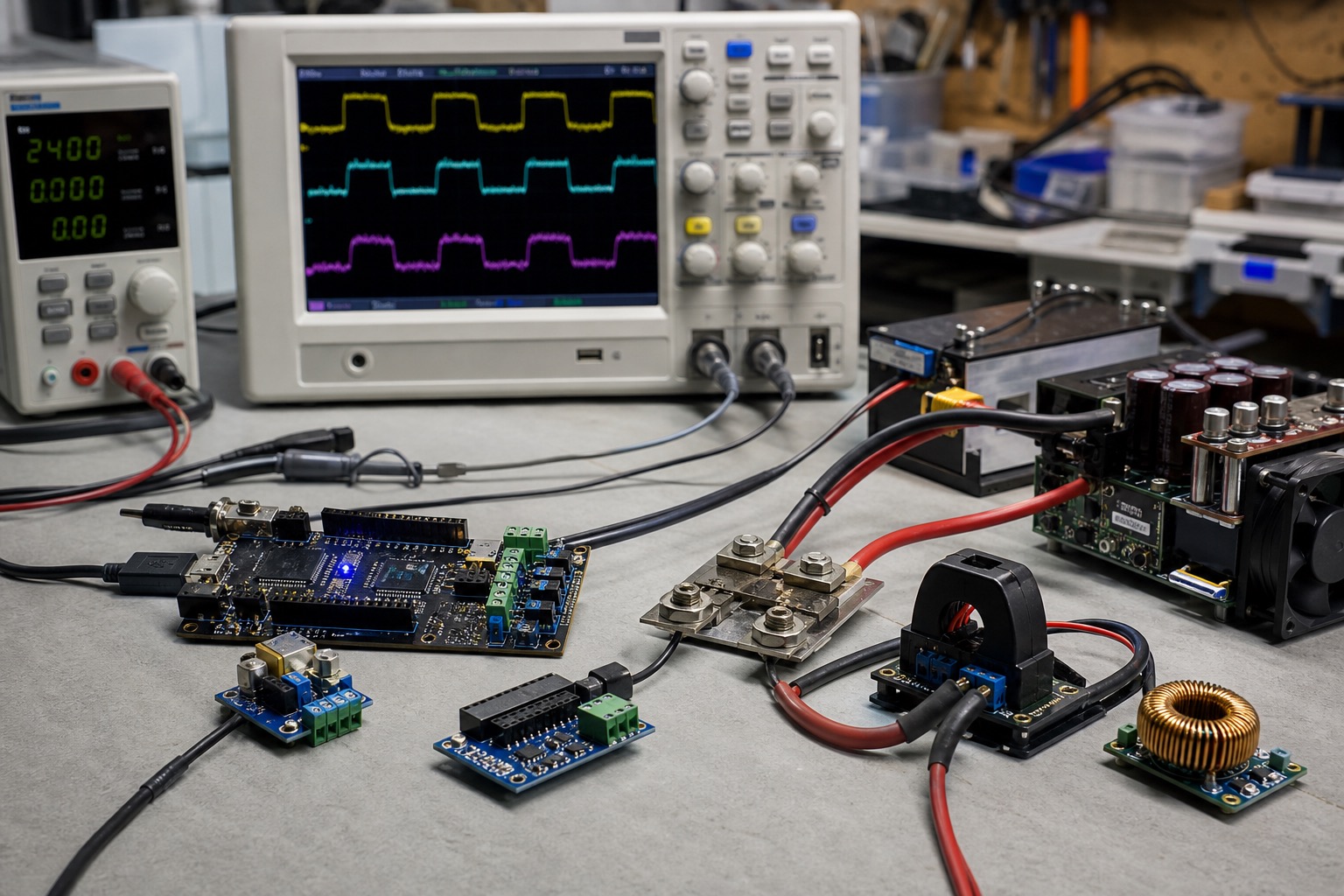
Current sensing topology choice is not "which chip is cheapest" — it's which error mechanism you can tolerate at your frequency, isolation requirement, and acceptable power loss. I bench-compared shunt + INA240, Allegro ACS770 Hall sensor, and a PE-67100 current transformer at 20 A steady-state and 50 A 10 kHz pulses on a motor drive test fixture.
Test fixture
- Supply: Rigol DP832A + 24 V bus, low-inductance return
- Load: Electronic load (BK Precision 8601) + parallel MOSFET pulse generator for fast edges
- Ground truth: Yokogawa WT310E on same bus bar (0.1% claimed accuracy)
- DUT placements: Kelvin shunt layout, Hall sensor on same conductor, CT on feed-through
All signals captured on Siglent SDS1104X-E (100 MHz, 1 GSa/s), diff probe on shunt, single-ended on Hall/CT with attention to common-mode.
Topology 1: Shunt + INA240A2 (gain 50)
Parts: 500 µΩ shunt (Isabellenhütte BVR), TI INA240A2, 3.3 V ADC (STM32G474 12-bit).
Sweet spot
- DC to ~100 kHz bandwidth (layout dependent)
- Best absolute accuracy in our test: ±0.4% at 20 A after two-point cal
- Lowest parts cost (~$4 shunt + $2 amp)
Tradeoffs measured
- Power loss: I²R = 20² × 500 µΩ = 200 mW at 20 A — fine. At 50 A pulse: 1.25 W — shunt heated, drift +0.3% until thermal equilibrium
- Common-mode: INA240 rated 80 V CM; fine on low-side shunt. High-side at 400 V bus needs different amp (INA240 not enough)
- Layout sensitivity: 2 mm trace mismatch between Kelvin sense pairs added 8 mA offset at zero — layout is part of spec
When I'd pick it
Motor control below 100 A, low-side sensing, cost-sensitive, MCU ADC available. Default choice.
Topology 2: Hall effect (Allegro ACS770LCB-100B-PFF-T)
Sweet spot
- Galvanic isolation without opto isolation amplifier
- Moderate bandwidth: datasheet 120 kHz, measured -3 dB ~85 kHz on our bar
- No insertion loss (conductor through package)
Tradeoffs measured
- Offset drift: ±20 mA zero offset at 25°C → ±0.1% at 20 A if lucky, ±0.5% after 40°C board warm-up without temp comp
- Nonlinearity: ±0.8% full scale per datasheet; observed ±0.6% 5–50 A
- Response to pulse: 50 A step, rise time ~6 µs vs <1 µs shunt path — fine for thermal management, marginal for fast OCP
When I'd pick it
High-side sensing, isolation required, moderate accuracy OK (thermal management, energy metering B-tier). Not for precision servo current loops.
Topology 3: Current transformer (PE-67100, 100 A rated)
With burden resistor 10 Ω → 50 mV/A secondary (turns ratio 1:1000).
Sweet spot
- High current AC or pulsed AC component
- Excellent isolation
- Negligible DC path loss
Tradeoffs measured
- No DC response — by design. 20 A DC + 2 A ripple: measures ripple only; DC invisible
- Phase shift: 5° at 10 kHz on pulse fundamental — matters for power factor correction control loops
- Burden resistor sizing: 10 Ω gave 2:1 SNR vs 5 Ω but saturation risk on 50 A peak — had to verify core doesn't saturate
When I'd pick it
AC load monitoring, ground fault detection, retrofits where insertion loss unacceptable. Pair with shunt if DC component needed — we didn't on this bench.
Comparison table (20 A steady, 25°C)
| Topology | Accuracy | Bandwidth | Isolation | Loss @ 20A | DC capable |
|---|---|---|---|---|---|
| Shunt + INA240 | ±0.4% | ~100 kHz | None (low-side) | 200 mW | Yes |
| Hall ACS770 | ±0.6% | ~85 kHz | Yes | ~0 | Yes |
| CT + burden | N/A at DC | ~300 kHz AC | Yes | ~0 | No |
50 A pulse findings
- Shunt: fastest response, thermal drift during repeated pulses — needed copper area on shunt pads
- Hall: acceptable OCP detection latency (~8 µs to threshold compare)
- CT: excellent AC component of pulse; useless for DC bus holdup monitoring
ADC and front-end notes
STM32G474 12-bit, 3.3 V ref, 50 mV full-scale on shunt path → ~16 mA LSB. Oversampling to 14-bit effective got ~4 mA resolution — enough for thermal management, not for mA standby detection.
For standby, separate ACS712 low-range or dedicated coulomb counting — different problem.
See bench PSU notes part 3 for how current limit loops closed in my home lab supply — shunt topology again, different scale.
Power sequencing matters when sensor rail comes up after power stage — INA240 outputs undefined until 3.3 V stable; blind spot during startup.
Layout checklist for shunt accuracy
Kelvin sense trace rules we enforce in review:
- Sense traces leave shunt pads on inner layer away from switch-node copper pour
- No vias between shunt and INA240 inputs — single-layer pair preferred
- Filter cap at INA240 supply pin, not at shunt
- Keep Hall sensor ≥5 mm from switch-node inductor — magnetic crosstalk added 15 mA offset in one layout spin
Temperature drift during soak
Hall sensor offset drift after 30 min at 20 A: +8 mA without compensation, +2 mA with one-point cal at 40°C soak start. Shunt drift dominated thermal EMF at +3 mA unless copper area generous — Isabellenhütte shunt outperformed cheap metal strip.
What I'd do next
- Test AMC1302 isolated delta-sigma for high-side 400 V bus — Hall alternative
- Characterize ** Rogowski coil** for wide dynamic range AC
- Build cal fixture with 0.05% reference shunt — trust but verify annually
Pick topology from frequency, isolation, and loss constraints — not from which eval board was in the drawer.

Manish Bookreader
Electronics enthusiast, Embedded Systems Expert, Linux/Networking programmer, and Software Engineer passionate about AI, electronics, books, and cooking.