Altium vs KiCad for a One-Person Hardware Consultancy: A 2024 Reassessment
Altium's perpetual license cost is hard to justify for intermittent consultancy work. KiCad 8's hierarchical schematic and constraint manager close most of the gap.
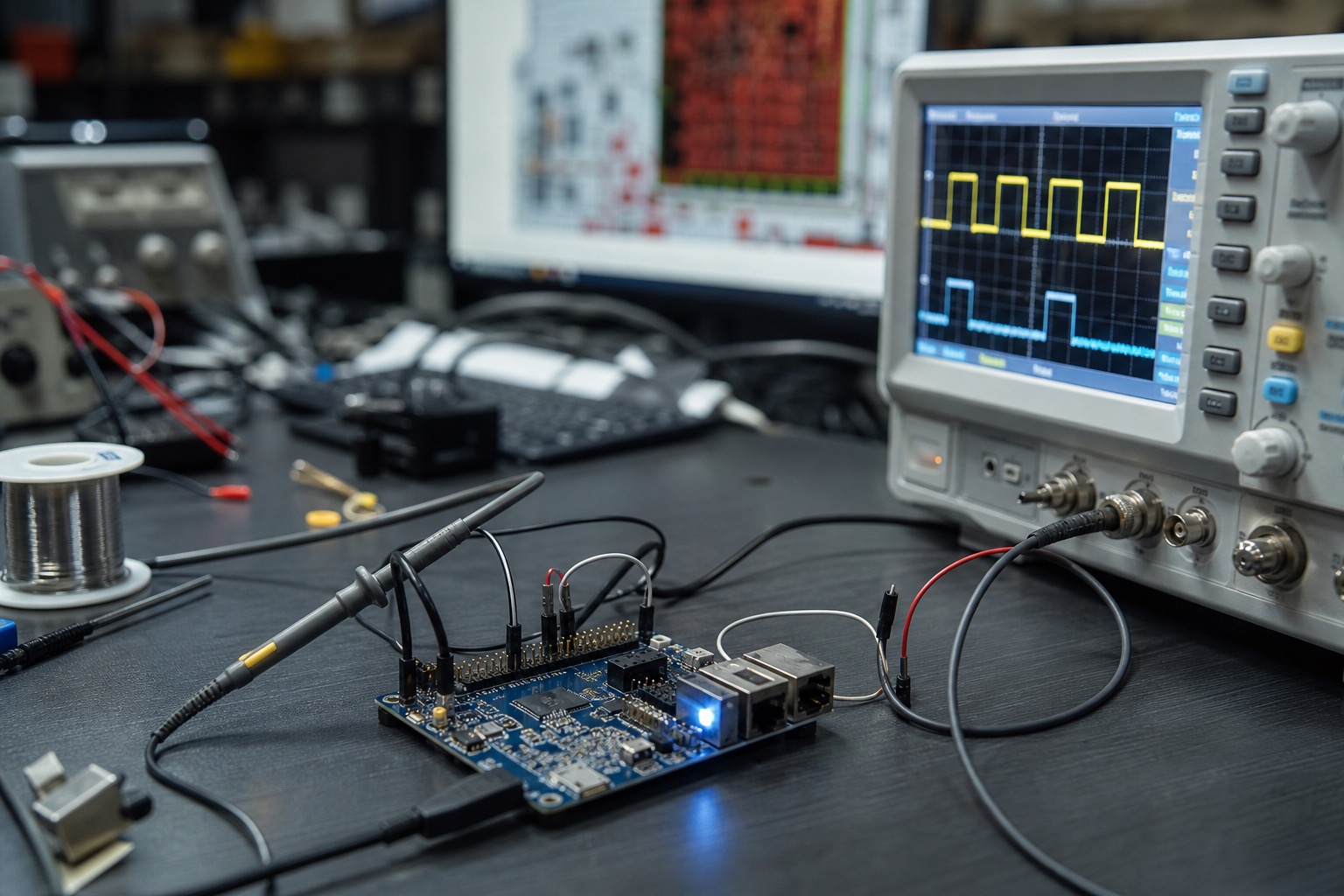
Altium Designer cost me $4,990/year (Node-locked subscription, 2023 renewal quote) for intermittent consultancy — roughly 4–6 board spins annually. KiCad 8 with its hierarchical schematic workflow and constraint manager closes most of the productivity gap. Not all. Honest 2024 reassessment from someone who used Altium 20+ for 12 years.
Usage profile (who this comparison is for)
One-person hardware consultancy:
- Mixed-signal boards, 4–8 layers, STM32/Nordic/Raspberry Pi CM carriers
- Schematics 40–200 components, moderate high-speed (USB 2.0, 100 Mbps Ethernet, not DDR4 SI consulting)
- Fab: JLCPCB / PCBWay, assembly often partial hand-solder + reflow oven
- Clients deliverables: Gerbers, BOM, assembly drawings, sometimes 3D STEP
Not: multi-designer enterprise with PLM integration, rigid flex at scale, or SI team running HyperLynx inside EDA.
Altium strengths that still hurt to lose
Unified database libraries
Altium DBLib linked to corporate part database — irrelevant for solo work. For consultancy, Ciiva / parts.io + manual symbols in KiCad is slower part entry (~15 min/part first time vs 5 min with saved DBLib templates).
Push-shove / interactive routing polish
Altium 23's push-shove on dense 6-layer boards still feels smoother than KiCad 8's router on equivalent layout. Quantified informally: ~20% longer route time on a 120-net USB+Ethernet carrier in KiCad.
Not 3x. Not zero. Matter of hours on a two-week layout.
Outjob / draftsperson automation
Assembly drawing generation, layer stack PDF for fab — Altium templates "just work." KiCad + community scripts or manual export. Added ~2 hours per project documentation time in KiCad.
Support and liability comfort
Some enterprise clients specify "Altium native files required." I eat the subscription for those clients only — ~30% of engagements.
KiCad 8 closes the gap
Tested KiCad 8.0.3 (upgraded from 7.x mid-2024):
Hierarchical sheets
Multi-sheet schematics with stable sheet pins — finally usable for reusable PMIC + MCU blocks. Same structure I used in Altium hierarchical design. Import from KiCad 7 projects: see KiCad 7 workflow changes.
Constraint manager (PCB)
Diff pair length tuning, impedance profiles tied to stackup — good enough for USB FS/HS and 100BASE-TX on standard JLC 4-layer stackups. Not replacing a $15k SI consultant on DDR3 — wasn't trying to.
3D / STEP export
FreeCAD integration acceptable for mechanical check with client enclosures. Altium 3D still prettier; both export STEP clients actually open.
Version control
Plain text S-expression files — git diffs on schematics beat Altium's XML/SVN history for solo rollback. Unexpected win.
Cost accounting (annual, solo consultancy)
| Item | Altium | KiCad 8 |
|---|---|---|
| License | ~$5,000 | $0 |
| Learning transition | $0 | ~40 hours one-time (billable opportunity cost) |
| Extra layout hours/project | baseline | +3–5 hours avg |
| Part obsolescence risk | subscription lapse = no edits | none |
Break-even: if KiCad costs <5 extra hours × billable rate × project count, KiCad wins on money. At $200/hr and 5 projects: 25 hours tolerance → KiCad wins if overhead <25h/year. My measured overhead ~18h — KiCad wins for default tooling.
Client deliverable friction
Some clients want PDF schematics with corporate title block — Altium outputs this in one click. KiCad plot + Inkscape title block template adds 45 min per project. Scripted export reduced to 15 min — one-time template investment.
Gerber review: both identical from fab perspective. Assembly house asked for centroid file — KiCad generates; Altium ODB++ preferred by one vendor we use twice yearly. ODB++ export from KiCad 8 improved; still verify pad rotation on fine-pitch QFN once per new footprint.
Licensing and export control
Neither tool affects ITAR/EAR directly — but client export-controlled designs sometimes mandate specific EDA audit trail. Altium 365 cloud history satisfied one aerospace client; KiCad git sufficed for others after legal review of commit metadata. Know client compliance before tool debate.
Supply chain workflow
KiCad + BOM export → component substitution during shortages spreadsheet. Altium ActiveBOM equivalent requires higher tier — I never paid for it; used external BOM tool either way.
When I still open Altium
- Client contract mandates native
.PcbDoc - Dense DDR layout with length-matched groups > 20 — speed worth subscription month
- Rigid-flex with complex bend regions — KiCad improving; not there for my skill level
Migration tips that worked
- Symbol/footprint lib one weekend — carry forward 80% from KiCad official + self-drawn 20%
- Don't convert old Altium projects — redraw small boards; import netlists only on large legacy
- Keep Altium read-only license one quarter for archive edits if budget allows — I let it lapse
What I'd do next
- Evaluate KiCad 9 nightly for router improvements — reassess annually
- Build personal template project (stackups, design rules, BOM scripts) — amortize setup
- Track hours/project in spreadsheet — emotion lies, data doesn't
Altium is still the smoother tool for dense professional layout. KiCad 8 is the rational default for intermittent consultancy work unless clients or DDR complexity pay the subscription for you.

Manish Bookreader
Electronics enthusiast, Embedded Systems Expert, Linux/Networking programmer, and Software Engineer passionate about AI, electronics, books, and cooking.