Component Substitution During Supply Chain Crunch: Risk Tiers and Documentation
2021–2022 forced every hardware team I know to substitute components. The ones that shipped without quality escapes were methodical about it. Here is the tier system we used.
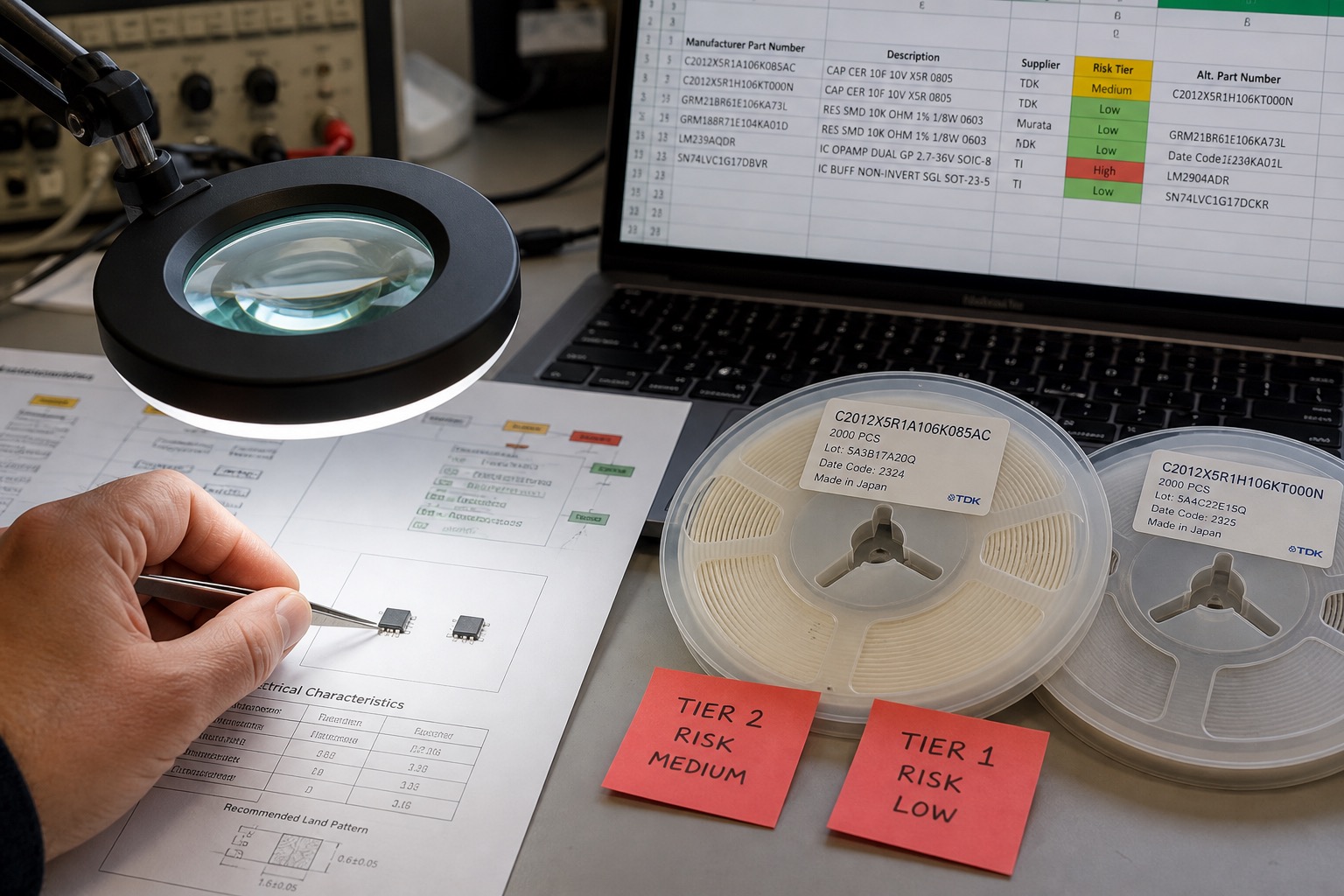
2021–2022 supply crunch forced every hardware team I worked with to substitute BOM lines. Teams that shipped without quality escapes were boring about it: risk tiers, documented equivalency tests, and revision-controlled BOMs. Teams that rushed shipped twice — once with wrong caps, once with silent EEPROM timing failures.
Tier system (still in use)
We classify every substitution before it hits the pick-and-place floor.
Tier 0 — Form-fit-function equivalent, same MPN family
Example: Samsung CL21B104KBCNNNC → CL21B104KBCLNNNC (same die, packaging variance).
Action: update AVL, no retest beyond incoming inspection sample.
Documentation: one-line ECO, supplier COFC.
Tier 1 — Electrical equivalent, different manufacturer
Example: Yageo RC0603FR-0710KL for Vishay CRCW060310K0FKEA.
Requirements:
- Parametric compare: R, tolerance, TCR, Vmax, power rating ≥ original
- Datasheet diff highlighted in ECO PDF
- Sample build 5 boards — ICT + functional smoke
- Reliability: if passives on critical timing (reset, crystal load), run temperature cycle 0–70°C × 20
Tier 2 — Functional equivalent, different topology
Example: LDO → pin-compatible different part (TPS7A4700 → AP2112K-3.3TRG1) — not actually pin-compatible if you only looked at SOT-23-5 outline.
Requirements:
- Schematic review by named EE
- SPICE or bench verify stability with actual output cap on board
- Full regression test suite on Tier 2 checklist (see below)
- Notify firmware if sequencing or power-good timing changes
We banned "pin-compatible" language without a pin function table review.
Tier 3 — Architectural change
Example: discrete FET + driver → integrated half-bridge, or MLCC shortage → tantalum on rail with different ESR.
Requirements:
- Mini design review (async memo format — RFCs that get read)
- Relayout or respin often required
- EMI re-scan if switching path changed — EMI bench notes
- Qual build 25+ units, field trial if safety-adjacent
AVL and PLM integration
Substitutions without PLM revision lock caused two builds with mixed BOM revisions — reel 1 old cap, reel 2 new. Pick-and-place does not care about your ECO PDF. Cut-in serial numbers are enforced at firmware flash: bootloader reads board ID EEPROM and refuses wrong calibration blob.
For automotive-adjacent SKUs, Tier 1+ requires AEC-Q match or explicit waiver signed by customer. We rejected "commercial temp" substitutes on industrial client contract without waiver — legal, not engineering call.
Communication with contract manufacturers
CMs will substitute without asking if AVL is ambiguous. We send approved alternates list with each PO; any deviation requires ECO number on packing slip. Two "equivalent" reel swaps from CM caused rework — now automatic reject at incoming if MPN not on line-item PO.
Long-term AVL hygiene post-crunch
We audit Tier 0 alternates quarterly — manufacturer discontinuations still happen. Octopart alert on NRND for any MPN with >$10k annual spend. Substitute research before stockout, not during.
Tier 3 substitutions require customer notification if fielded units exist — even when form-fit-function holds electrically. Support contracts care about firmware compatibility, not just smoke test pass.
Photo archive: store top and bottom assembly photos with each ECO closure — visual diff catches wrong reel orientation on polarized parts faster than parametric tables alone.
Documentation template (every Tier 1+)
ECO-#### header with:
- Original MPN / manufacturer / last buy date
- Substitute MPN / manufacturer / allocation proof
- Tier classification + approver signatures (EE, QA, ops)
- Parametric table (min 8 rows: V, I, temp, package, AEC if automotive)
- Test evidence links (ICT log, thermal image if power part — thermal camera cases)
- Rollback plan: remaining old stock location, cut-in serial number
Stored in hardware/eco/ git + PLM export. No Slack approval screenshots as sole record.
Tier 2 test checklist (abbreviated)
- Power rails in spec at min/max input voltage
- Inrush current ≤ fuse rating
- Boot / programming / JTAG
- All comms interfaces (CAN, RS485, USB-CDC) at corner temp
- Sleep current budget
- ESD spot check if I/O transceiver changed
Failures we avoided with tiers
Cap voltage derating: substitute 16 V X7R on 12 V bus — fine. Same line on 15 V bus — silent 6-month failures. Tier 1 now requires application voltage column, not just catalog rating.
Crystal load caps: swapped 18 pF → 22 pF "close enough" — UART drift at cold. Tier 1 for timing nets now mandates frequency margin test on 3 units.
EEPROM AT24C256 → ON Semi equivalent: different page write timing — firmware hard-coded 5 ms delay insufficient at 85°C. Tier 2 caught in chamber; would have been Tier 0 mistake.
KiCad / BOM hygiene
Substitutions without library symbol update caused assembly right-part-wrong-footprint twice. Rule: no ECO closed until fp-lib-table and schematic fields updated — ties to KiCad 7 workflow.
What I'd do next
Build parametric search saved queries in Octopart/SiliconExpert per tier-0 approved alternates — reduce panic substitution.
Automate ECO PDF generation from YAML — human signs, machine generates diff table.
For long-lead ASICs, maintain approved second source list in contract negotiations again — crunch taught us; peace made us lazy.

Manish Bookreader
Electronics enthusiast, Embedded Systems Expert, Linux/Networking programmer, and Software Engineer passionate about AI, electronics, books, and cooking.