EMI Bench Testing Notes: What a Spectrum Analyzer Under $500 Actually Shows You
Pre-compliance EMI testing with a $400 SDR and a near-field probe set tells you more than you'd expect — and less than you need for a formal chamber test.
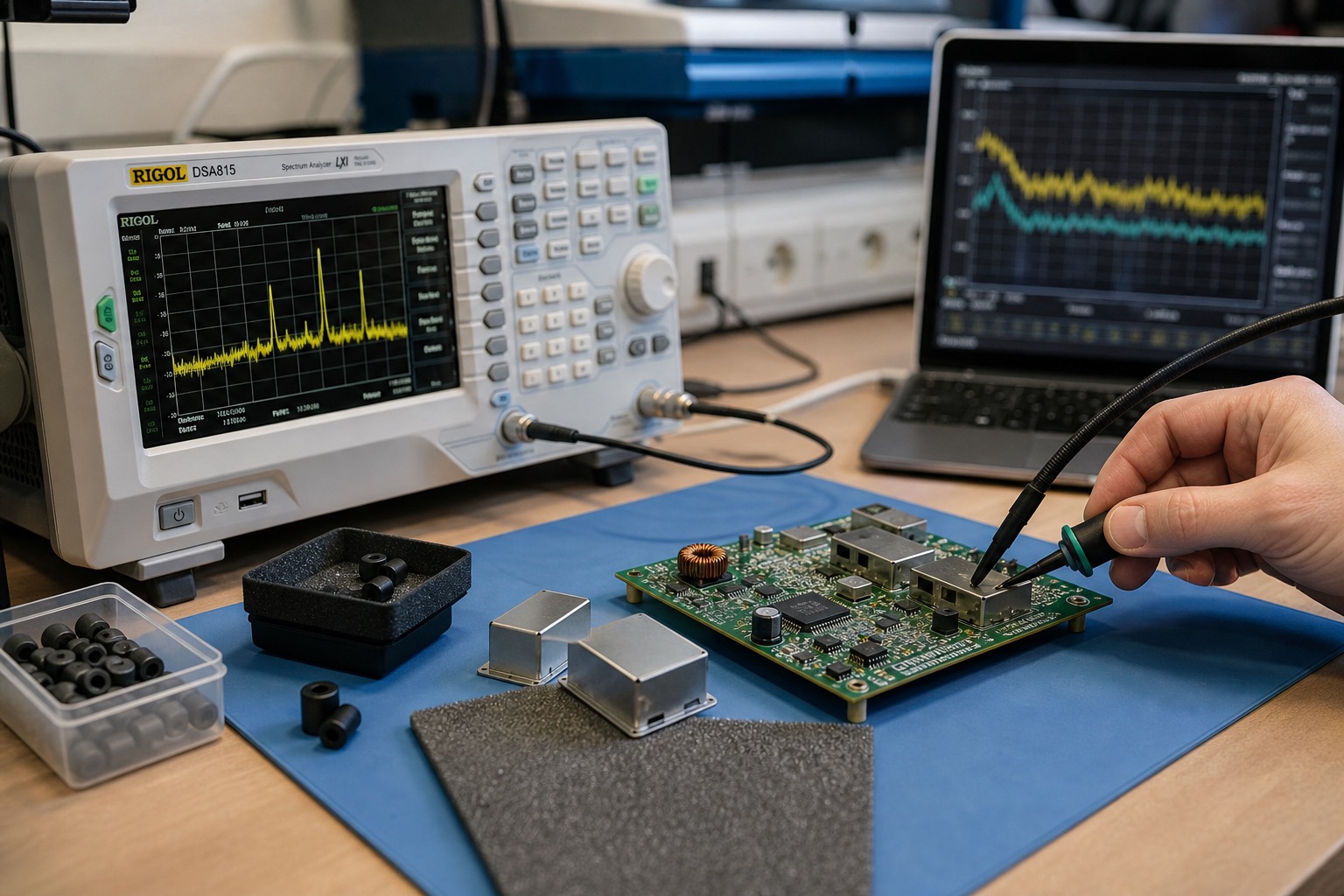
Pre-compliance EMI testing with a $400 SDR and a near-field probe set tells you more than you'd expect — and less than you need for a formal chamber test. Notes from bench sessions on a wearable hub before we paid for a semi-anechoic slot.
Setup
- SDR: RTL-SDR Blog V3 (~$40) + Ham It Up upconverter optional for sub-100 MHz — we used direct sampling hack for HF on V3
- Spectrum software: SDR++ 1.1 on Linux; later borrowed Rigol DSA815 for comparison
- Probes: BeeHive 101A near-field H-field set (~$180 used) + homemade loop from coax
- DUT: nRF52840 wearable hub, 2-layer flex, BLE advertising + 200 Hz IMU SPI
Goal: find "obvious stupid" emissions before FCC unintentional radiator filing — not certify.
What a sub-$500 bench shows
You can rank fixes
Before/after comparisons reliable relative to your bench setup:
| Change | ~Peak at 2440 MHz (BLE) | Harmonic 4880 MHz |
|---|---|---|
| Baseline layout | -42 dBm ref | -50 dBm |
| Add π-filter on antenna feed | -48 dBm | -58 dBm |
| Fix ground stitch under nRF | -52 dBm | -62 dBm |
| Shield can (prototype tin) | -58 dBm | -70 dBm |
Absolute dBm meaningless vs. chamber; delta guides where to spend layout time.
You find clock harmonics fast
Sweep 30–3000 MHz with H-probe over MCU crystal, SPI SCK, DC-DC SW node. Our ADXL355 SPI at 5 MHz showed strong 15 MHz, 25 MHz spurs — series R on SCK cut 8 dB at third harmonic (correlated with SPI debug session).
Use narrow RBW (3 kHz) for spur hunting; wide RBW (100 kHz) for BLE band shape.
Near-field localization works
H-probe peaks over physical source — DC-DC inductor vs. antenna mismatch vs. cable acting as radiator. E-probe (when we borrowed one) showed flex cable edge as slot antenna — reroute ground return dropped cable radiation.
Pair with scope triggers on DC-DC switching node to time-correlate spur frequency with Fsw.
What it doesn't show
- Conducted emissions on USB/power lines — need LISN ($$$ or rental)
- Far-field levels — near-field peak ≠ pass/fail at 3 m distance
- Absolute compliance margin — your -58 dBm isn't FCC Part 15.247 limit translated
- Spurious under load modulation — BLE frequency hopping smears in cheap SDR; use dedicated receiver or chamber for final
Formal chamber quote: $3.2k/day regional — still needed; bench saved two revisits (~$6k + 3 weeks).
Method (repeatable)
- Golden photo of probe position per test — reproducibility matters more than calibration.
- Max hold spectrum 60 s normal operation mode.
- Mark suspected frequencies — correlate to clocks in firmware (
grep MHz schematic). - One change at a time — or you'll argue with yourself.
- Log environmental: laptop PSU 2 m away added 30 MHz garbage until we switched to battery laptop.
SDR++ settings that worked
Start: 2400 MHz, Stop: 2483 MHz, RBW: 10 kHz
Antenna: near-field probe via 30 dB attenuator (protect SDR front-end)
Without attenuator, overload falsifies peaks when probe near hot spot.
GPS timing side experiment
Same SDR bench used for GPS timing notes — 1 PPS reference helped correlate EMI events to radio TX schedule; BLE connection event every 30 ms visible as comb.
Real findings that shipped fixes
- Missing ground under nRF ANT pin — layout tool poured wrong; bench caught, chamber would have failed radiated.
- Heater PWM on same return as RF — moved return path; conducted noise on battery line dropped (measured with scope + current probe, not SDR alone).
- USB-C cable shield termination — PD board flex transition; SDR showed 480 MHz spike when cable attached.
When to stop bench and book chamber
- Product intentional radiator (BLE, Wi-Fi) — yes, schedule chamber early for baseline
- Delta fixes plateau — last 3 dB may need chamber to verify far-field
- Customer contract requires third-party lab report — bench isn't legal evidence
Equipment upgrade path
If budget allows one step up: Rigol DSA815-TG (~$1.5k used) — tracking generator for filter validation. Still not chamber.
Near-field probes: buy once, use on every rev.
What I'd do next
Build emi-snapshots/ repo folder — PNG + probe position JSON per board rev. CI can't run EMI yet; human diff catches regressions when mechanical team rotates antenna 2 mm.
Train every HW engineer on 2-hour SDR bench orientation — cheaper than one chamber redo.
Pre-compliance EMI with cheap gear is triage, not verdict. Use it to make chamber visits boring.
SDR limitations we hit
- Overload near BLE antenna — false harmonics without 30 dB attenuator
- Image responses below ~24 MHz on V3 — know your dongle's aliasing
- No conducted emissions — LISN still rental
Borrowed DSA815 correlated one near-field peak to far-field — within 6 dB on one spur; not repeatable on all — still useful for trend.
Shield can prototype economics
Tin can + copper tape: $3, 2 dB improvement on 2.4 GHz spur. Production shield: $0.41 BOM + pick-place. Bench proves worth before mechanical commits.
What I'd do next

Manish Bookreader
Electronics enthusiast, Embedded Systems Expert, Linux/Networking programmer, and Software Engineer passionate about AI, electronics, books, and cooking.