Home Lab Safety Notes: Mains Isolation, LiPo Charging, and Laser Diodes
Three near-misses over ten years of home lab work. What I changed in my setup and what I wish I had done earlier.
Three near-misses in ten years of home lab work changed how I wire mains, charge LiPo cells, and handle laser diodes. None produced a hospital visit. All three would have been preventable with habits I now treat as non-optional. This is not a safety certification guide — it is what I changed after doing things wrong.
If you are doing RF work with open bench setups, see EMI bench testing notes. If you are disciplining clocks with GPS gear near windows, SDR GPS timing notes covers the antenna side.
Near-miss 1: isolation transformer I trusted too much
Setup: Variac → isolation transformer (Hammond 1182V12, 250 VA) → bench supply → DUT probing a mains-referenced motor controller.
What happened: I measured 120 VAC between the DUT ground plane and earth ground. The "isolated" supply was floating, but my scope ground clip was earth-referenced. The motor controller bridge tied "DC ground" to AC neutral internally.
What almost happened: Scope ground became a return path for mains current. The spark was at the clip, not through me — luck and a GFCI upstream.
What I changed:
-
Isolation transformer is not isolation from earth. It breaks the neutral-earth bond on the secondary. Everything downstream floats. Your scope ground is still earth. Treat every measurement as "where does current return?"
-
Differential probe or battery-powered scope for probing unknown mains-adjacent boards. I bought a PicoScope 2204A (~$200 used) for floating measurements. Cheaper than one ER visit.
-
Label the isolation chain. Red tape on the variac output: "FLOATING — scope ground is NOT safe here."
-
GFCI on the bench circuit. Non-negotiable. Trip threshold saved me once on a different incident with a frayed IEC cord.
Near-miss 2: LiPo charging on the bench supply
Setup: 2S LiPo (800 mAh) "charged" by setting bench supply to 8.4 V CC/CV with current limit 500 mA. No balance leads. No proper charger.
What happened: Cell 1 reached 4.35 V, cell 2 at 4.05 V (measured after I got suspicious of swelling). Pack puffed slightly. Disposed of it in salt water bath per local hazmat guidance.
Root cause: Two cells in series with one voltage measurement point. CC/CV at the pack terminals does not balance. The bench supply has no cell-level termination.
What I changed:
-
ISDT Q6 Plus (~$35) or SkyRC iMAX B6 clone with known-good firmware for any LiPo. Balance leads connected every time.
-
LiPo bags for charge and storage. Metal ammo can with vent holes if you are paranoid (I am).
-
Never CC/CV from bench supply on multi-cell packs. Single-cell 4.20 V at 500 mA limit is acceptable for emergencies with direct cell tabs and thermal probe (see below). Multi-cell: no.
-
Thermal probe on charge. ISDT has temp sensor input. I set cutoff at 45 °C. On bench single-cell trickle, I hold the IR thermometer like a superstition that works.
Storage voltage: 3.80 V per cell for anything not flying within a week. I write the storage date on the bag in Sharpie.
Near-miss 3: 650 nm laser diode without current limit
Setup: Osram PLT5 650 nm laser diode, datasheet says 45 mA max I_fwd. I wired it to 3.3 V through a 68 Ω resistor (≈48 mA nominal) and a pot for "fine adjust."
What happened: Pot wiper went open during adjustment. Uncontrolled current path through the static protection network. Dead laser in ~200 ms. Smelled like burnt phosphor.
Root cause: Laser diodes are current devices, not voltage devices. A resistor is not a current source. Any open in the limit path equals COD (catastrophic optical damage).
What I changed:
-
Dedicated laser driver IC. AL8860 (~$1) or simple two-transistor current source with hard ceiling. Set with calculated resistor, not a panel pot on the high side.
-
Current limit before connect. Multimeter in mA range in series, verify < 40 mA before removing.
-
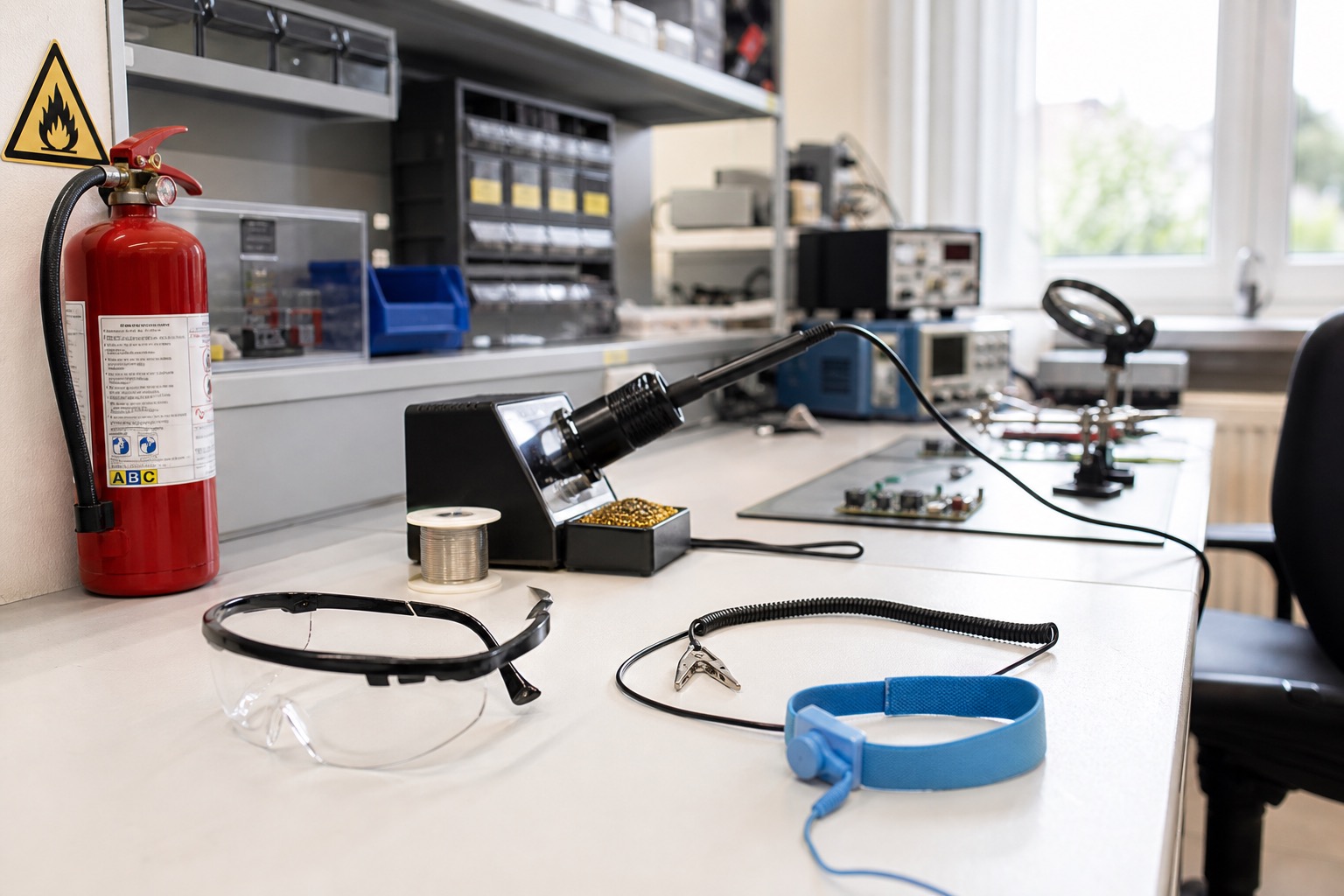
ESD mat and wrist strap for handling. Laser chips are static-sensitive. The dead unit may have been ESD before the pot incident. I will never know.
-
Safety glasses OD 4+ at wavelength. 650 nm looks harmless. Scattered reflection off a lens can still cause flash blindness. I use Thorlabs LG4 for alignment and block the beam with a card when not measuring.
General habits now enforced
Power-off wiring. No hot-plugging jumper wires on powered breadboards. Sounds obvious. I still catch myself reaching for a scope probe on a live 48 V PoE experiment.
Fire extinguisher class ABC, 5 lb, within arm's reach. Not the kitchen one down the hall.
Ventilation for solder, flux, 3D printer enclosures. Resin printers are a separate hazard category — IPA storage outside the house.
First-aid kit with burn gel. Touched a 300 °C hot end once. The gel helped; pride did not.
Equipment I consider worth the cost
| Item | Purpose | Approx cost |
|---|---|---|
| GFCI outlet or breaker | Bench circuit | $25 |
| LiPo charge bag | Containment | $8 |
| ISDT Q6 Plus | Proper charging | $35 |
| Laser safety glasses (OD 4+) | 650 nm work | $40 |
| PicoScope or diff probe | Floating measurement | $200+ |
| IR thermometer | Thermal spot checks | $25 |
What I wish I had done earlier
Taken the 30-minute NFPA-adjacent community college night class on electrical safety. YouTube videos on isolation transformers are not the same as someone showing you where your scope ground clip completes a circuit.
Written a one-page "lab rules" sheet and taped it above the bench before incident two, not after.
What I would still not do
Work alone on mains voltage inside enclosed products without a buddy check. I do mains work at the bench with breakers identified and a phone in pocket. I do not work tired.
Trust any "isolated" label without drawing the ground loop on paper first. Paper is free.
Related
RF and clock setups often mean cables near windows and long USB runs: SDR GPS timing notes. EMI from switchers can surprise you during safety-critical measurements: EMI bench testing notes.

Manish Bookreader
Electronics enthusiast, Embedded Systems Expert, Linux/Networking programmer, and Software Engineer passionate about AI, electronics, books, and cooking.