Attention Is All You Need: Transformer Architecture Paper Analysis
Deep dive into the seminal "Attention Is All You Need" paper by Vaswani et al., analyzing the Transformer architecture, its innovations, and lasting impact on modern NLP and beyond.
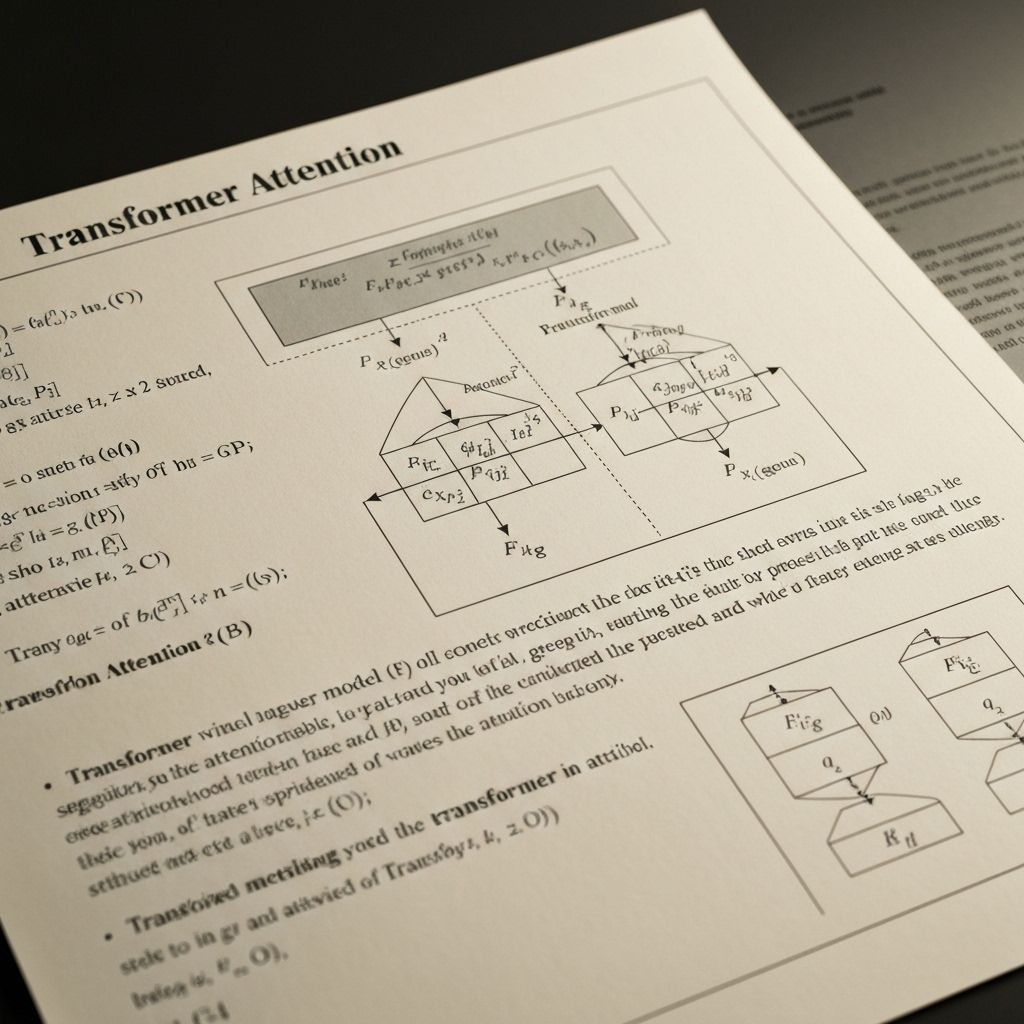
Attention Is All You Need: Transformer Architecture Paper Analysis
The 2017 paper "Attention Is All You Need" by Vaswani et al. fundamentally transformed the landscape of deep learning and natural language processing. This analysis examines the paper's key contributions, technical innovations, and lasting impact on the field.
Paper Overview
Title: Attention Is All You Need
Authors: Ashish Vaswani, Noam Shazeer, Niki Parmar, Jakob Uszkoreit, Llion Jones, Aidan N. Gomez, Lukasz Kaiser, Illia Polosukhin
Institution: Google Brain
Publication: NIPS 2017
Citations: 50,000+ (as of 2024)
Historical Context
Pre-Transformer Era (2010-2017)
Dominant Architectures:
- Recurrent Neural Networks (RNNs)
- Long Short-Term Memory (LSTM)
- Gated Recurrent Units (GRUs)
- Seq2Seq models with attention
Key Limitations:
- Sequential processing bottleneck
- Vanishing gradient problems
- Limited parallelization
- Difficulty capturing long-range dependencies
The Attention Mechanism Evolution
Bahdanau et al. (2014): First attention mechanism for neural machine translation Luong et al. (2015): Improved attention variants Rush et al. (2015): Attention for summarization
The Transformer paper asked: "What if we rely entirely on attention?"
Core Innovations
1. Self-Attention Mechanism
The fundamental breakthrough was self-attention, allowing each position to attend to all positions in the input sequence.
Mathematical Formulation:
Attention(Q, K, V) = softmax(QK^T / √d_k)V
Where:
- Q (Queries): What we're looking for
- K (Keys): What we're searching through
- V (Values): The actual content to retrieve
- d_k: Dimension scaling factor
Multi-Head Attention:
class MultiHeadAttention:
    def __init__(self, d_model, num_heads):
        self.num_heads = num_heads
        self.d_model = d_model
        self.d_k = d_model // num_heads

        self.W_q = Linear(d_model, d_model)
        self.W_k = Linear(d_model, d_model)
        self.W_v = Linear(d_model, d_model)
        self.W_o = Linear(d_model, d_model)

    def scaled_dot_product_attention(self, Q, K, V, mask=None):
        scores = torch.matmul(Q, K.transpose(-2, -1)) / math.sqrt(self.d_k)

        if mask is not None:
            scores = scores.masked_fill(mask == 0, -1e9)

        attention_weights = F.softmax(scores, dim=-1)
        output = torch.matmul(attention_weights, V)

        return output, attention_weights

    def forward(self, x, mask=None):
        batch_size, seq_len, d_model = x.size()

        # Generate Q, K, V
        Q = self.W_q(x).view(batch_size, seq_len, self.num_heads, self.d_k).transpose(1, 2)
        K = self.W_k(x).view(batch_size, seq_len, self.num_heads, self.d_k).transpose(1, 2)
        V = self.W_v(x).view(batch_size, seq_len, self.num_heads, self.d_k).transpose(1, 2)

        # Apply attention
        attention_output, attention_weights = self.scaled_dot_product_attention(Q, K, V, mask)

        # Concatenate heads
        attention_output = attention_output.transpose(1, 2).contiguous().view(
            batch_size, seq_len, d_model)

        # Final linear transformation
        output = self.W_o(attention_output)

        return output
2. Positional Encoding
Since Transformers have no inherent notion of sequence order, positional encoding was introduced:
def positional_encoding(seq_len, d_model):
    pe = torch.zeros(seq_len, d_model)
    position = torch.arange(0, seq_len).unsqueeze(1).float()

    div_term = torch.exp(torch.arange(0, d_model, 2).float() *
                        -(math.log(10000.0) / d_model))

    pe[:, 0::2] = torch.sin(position * div_term)
    pe[:, 1::2] = torch.cos(position * div_term)

    return pe
3. Complete Architecture
Encoder-Decoder Structure:
- 6 encoder layers, 6 decoder layers
- Each encoder layer: Multi-head attention + Feed-forward network
- Each decoder layer: Masked multi-head attention + Encoder-decoder attention + Feed-forward network
Technical Deep Dive
Attention Complexity Analysis
Time Complexity:
- Self-attention: O(n²d) where n is sequence length, d is dimension
- RNN: O(nd²)
- CNN: O(knd²) where k is kernel size
Space Complexity:
- Attention matrix: O(n²) memory requirement
- Significant for very long sequences
Layer Normalization and Residual Connections
class TransformerEncoderLayer:
    def __init__(self, d_model, num_heads, d_ff, dropout=0.1):
        self.self_attention = MultiHeadAttention(d_model, num_heads)
        self.feed_forward = FeedForward(d_model, d_ff)
        self.norm1 = LayerNorm(d_model)
        self.norm2 = LayerNorm(d_model)
        self.dropout = Dropout(dropout)

    def forward(self, x, mask=None):
        # Self-attention with residual connection and layer norm
        attn_output = self.self_attention(x, mask)
        x = self.norm1(x + self.dropout(attn_output))

        # Feed-forward with residual connection and layer norm
        ff_output = self.feed_forward(x)
        x = self.norm2(x + self.dropout(ff_output))

        return x
Experimental Results
Machine Translation Performance
WMT 2014 English-German:
- Transformer (base): 27.3 BLEU
- Previous SOTA (ConvS2S): 25.16 BLEU
- Training time: Significantly reduced
WMT 2014 English-French:
- Transformer (big): 41.8 BLEU
- Previous SOTA: 40.4 BLEU
Computational Efficiency
Training Speed:
- 3.5 days on 8 P100 GPUs (base model)
- 2.5 days on 8 P100 GPUs (big model)
- Previous models required weeks
Inference Speed:
- Highly parallelizable
- Faster inference than RNN-based models
- Better GPU utilization
Impact and Applications
Natural Language Processing Revolution
Pre-trained Language Models:
- BERT (2018): Bidirectional encoder representations
- GPT series (2018-2023): Generative pre-training
- T5 (2019): Text-to-text transfer transformer
- Switch Transformer (2021): Sparse expert models
Beyond NLP Applications
Computer Vision:
- Vision Transformer (ViT): Image classification
- DETR: Object detection
- Swin Transformer: Hierarchical vision transformer
Other Domains:
- Protein folding (AlphaFold)
- Music generation
- Code completion
- Reinforcement learning
Theoretical Contributions
Attention as Graph Operations
Self-attention can be viewed as operations on complete graphs:
- Each token is a node
- Attention weights are edge weights
- Information flows along weighted edges
Inductive Biases
Removed Biases:
- Sequential processing assumption
- Local connectivity preference
- Translation equivariance
Retained Flexibility:
- Learned position representations
- Dynamic attention patterns
- Content-based routing
Implementation Considerations
Memory Optimization
Gradient Checkpointing:
def checkpoint_forward(self, x):
    # Trade computation for memory
    return torch.utils.checkpoint.checkpoint(self.forward_impl, x)
Attention Optimization:
- Flash Attention: Memory-efficient attention
- Linear attention approximations
- Sparse attention patterns
Training Stability
Learning Rate Scheduling:
def transformer_lr_schedule(step, d_model, warmup_steps=4000):
    arg1 = step ** -0.5
    arg2 = step * (warmup_steps ** -1.5)
    return d_model ** -0.5 * min(arg1, arg2)
Initialization Strategies:
- Xavier/Glorot initialization for linear layers
- Careful attention weight initialization
- Layer normalization positioning
Limitations and Criticisms
Computational Requirements
Memory Consumption:
- O(n²) memory for attention matrix
- Prohibitive for very long sequences
- GPU memory limitations
Energy Consumption:
- Large models require significant computational resources
- Environmental impact concerns
- Inference costs
Theoretical Understanding
Black Box Nature:
- Limited interpretability of attention patterns
- Unclear what linguistic phenomena are captured
- Attention weights may not reflect importance
Generalization Questions:
- How much data is required for good performance?
- What inductive biases are implicitly learned?
- Robustness to distribution shifts
Subsequent Developments
Efficiency Improvements
Linear Attention:
- Performer (2020): FAVOR+ algorithm
- Linformer (2020): Linear complexity attention
- FNet (2021): Fourier transforms instead of attention
Sparse Attention:
- Longformer (2020): Sliding window attention
- BigBird (2020): Random + global attention
- Sparse Transformer (2019): Strided attention patterns
Architectural Innovations
Encoder-Only Models: BERT, RoBERTa, DeBERTa Decoder-Only Models: GPT series, PaLM, Chinchilla Encoder-Decoder Models: T5, BART, Pegasus
Modern Perspective (2024)
Scaling Laws
Empirical Observations:
- Performance improves predictably with scale
- Compute-optimal training (Chinchilla scaling)
- Emergent abilities at sufficient scale
Current Challenges:
- Diminishing returns on scale
- Alignment and safety concerns
- Computational sustainability
Future Directions
Architecture Evolution:
- Mixture of Experts scaling
- Retrieval-augmented generation
- Multi-modal transformers
- State space models (Mamba, etc.)
Application Domains:
- Scientific computing
- Drug discovery
- Materials science
- Climate modeling
Code Implementation Guide
Basic Transformer Implementation
import torch
import torch.nn as nn
import math

class Transformer(nn.Module):
    def __init__(self, src_vocab_size, tgt_vocab_size, d_model=512,
                 num_heads=8, num_layers=6, d_ff=2048, dropout=0.1):
        super().__init__()

        self.d_model = d_model
        self.src_embedding = nn.Embedding(src_vocab_size, d_model)
        self.tgt_embedding = nn.Embedding(tgt_vocab_size, d_model)
        self.pos_encoding = PositionalEncoding(d_model, dropout)

        encoder_layer = TransformerEncoderLayer(d_model, num_heads, d_ff, dropout)
        self.encoder = TransformerEncoder(encoder_layer, num_layers)

        decoder_layer = TransformerDecoderLayer(d_model, num_heads, d_ff, dropout)
        self.decoder = TransformerDecoder(decoder_layer, num_layers)

        self.output_projection = nn.Linear(d_model, tgt_vocab_size)

    def forward(self, src, tgt, src_mask=None, tgt_mask=None):
        src_emb = self.pos_encoding(self.src_embedding(src) * math.sqrt(self.d_model))
        tgt_emb = self.pos_encoding(self.tgt_embedding(tgt) * math.sqrt(self.d_model))

        memory = self.encoder(src_emb, src_mask)
        output = self.decoder(tgt_emb, memory, tgt_mask, src_mask)

        return self.output_projection(output)
Conclusion
"Attention Is All You Need" stands as one of the most influential papers in modern AI, fundamentally changing how we approach sequence modeling and representation learning. Its elegant simplicity - replacing complex recurrent architectures with pure attention mechanisms - enabled the current era of large language models and multimodal AI systems.
Key Contributions:
- Architectural Innovation: Pure attention-based sequence modeling
- Computational Efficiency: Highly parallelizable training and inference
- Performance Breakthrough: State-of-the-art results across multiple tasks
- Foundation for Modern AI: Enabled GPT, BERT, and subsequent developments
Lasting Impact:
- Transformed NLP from task-specific to general-purpose models
- Enabled scaling to unprecedented model sizes
- Created new research directions in attention mechanisms
- Influenced domains far beyond natural language processing
Rating: 5/5 stars
Historical Significance: Revolutionary
Technical Merit: Exceptional
Practical Impact: Transformative
Reproducibility: Good (implementation details provided)
The Transformer architecture represents a rare instance where theoretical elegance aligns perfectly with practical effectiveness, creating a foundation that continues to drive AI progress nearly seven years after publication.

Manish Bookreader
Electronics enthusiast, Embedded Systems Expert, Linux/Networking programmer, and Software Engineer passionate about AI, electronics, books, and cooking.