Bench Power Supply Autobiography, Part 1: Why I Stopped Using the Lab Supply
A digital lab supply with a $300 price tag failed to hold a stable rail when the load stepped. The odyssey toward building my own started here.
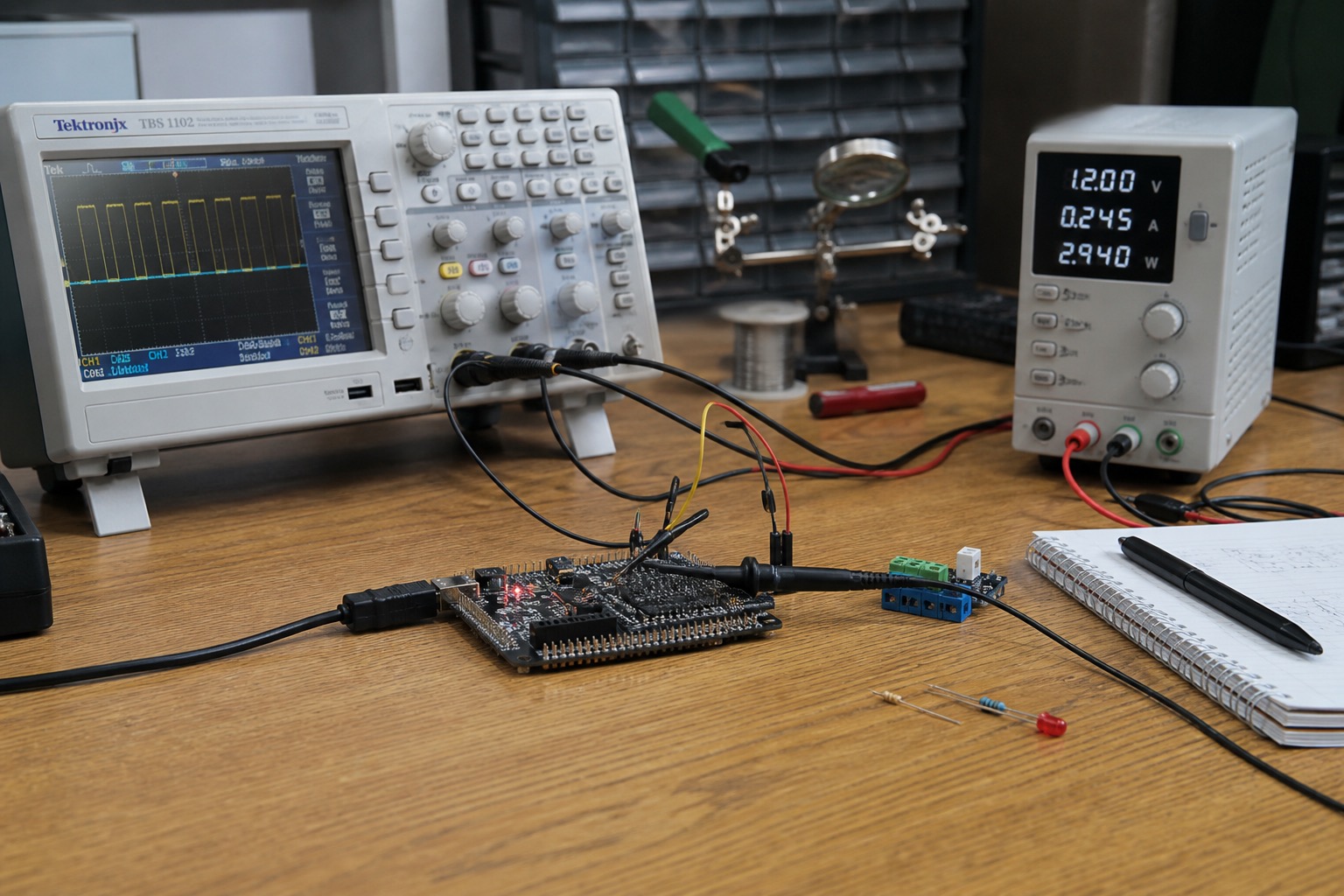
A $289 Korad KA3005P sat on my bench for two years before I admitted it was the wrong tool. Not broken — worse than that. It worked well enough on static loads that I kept rationalizing the purchase. Then I stepped a 500 mA load on a 3.3 V rail and watched the output ring at 180 mV peak-to-peak for three milliseconds before settling. That is fine for charging a phone. It is not fine for bringing up an STM32 with a brown-out detector set to 3.0 V.
This is Part 1 of a series on building a bench supply I actually trust. The conclusion upfront: I stopped using the lab supply for anything that matters and started designing my own linear front-end. Part 2 covers the LT3080 architecture; Part 3 covers current limiting without oscillation. If you are evaluating USB-C PD adapters for bench use, see USB-C PD confusion notes.
The failure mode I kept ignoring
The Korad is a switch-mode pre-regulator feeding a linear post-regulator — a reasonable topology at this price point. On a DMM reading, 3.300 V looked stable. On a Rigol DS1054Z at 500 mV/div and 1 ms/div, the story was different.
Test setup:
- Load: electronic load set to CC mode, 0 → 500 mA step in ~50 µs (as fast as the load allows)
- Output cap on DUT side: 10 µF ceramic + 100 nF (typical dev board)
- Probe: 10× at the load terminals, not at the supply binding posts
At 12 V input, 3.3 V / 500 mA output, I measured:
- Overshoot to 3.48 V (5.5%)
- Undershoot to 3.12 V
- Three visible ringing cycles before settling under 50 mV
The Korad datasheet claims <0.01% + 3 mV load regulation. That spec is measured at DC steady state. My failure was treating a catalog number as a guarantee under transient conditions.
What I tried before giving up
Remote sense. The Korad has sense inputs. I wired them to the DUT. Load regulation improved at DC — maybe 2 mV drift instead of 8 mV — but the step response barely changed. The problem is upstream of the sense loop: the switcher pre-regulator is slow relative to the load step.
Output cap at the supply. I added 470 µF electrolytic at the binding posts. Ringing amplitude dropped; settling time doubled. Now I had a supply that was slow and still overshot on fast steps.
Linear-only mode. Some Korad units have a "linear" or low-noise mode. Mine did not. Even if it had, a 12→3.3 V drop at 500 mA is 4.35 W dissipated in the post-regulator. The unit thermally throttled after ten minutes.
Better commercial supply. I looked at Rigol DP832 ($900) and Siglent SPD3303X ($650). Both are fine instruments. I was not willing to spend that for a home lab when the failure mode I cared about — low-noise, fast-recovery linear regulation at sub-5 V — is achievable for less in parts.
Requirements I wrote down
Before opening a schematic, I listed what "bench supply I trust" means for my actual work:
| Requirement | Target | Why |
|---|---|---|
| Output noise (10 Hz–100 kHz) | < 1 mV RMS | ADC reference, op-amp rails |
| Load step response (0→1 A) | < 50 mV overshoot, < 1 ms settle | MCU brown-out margins |
| Current limit | Adjustable, predictable foldback or constant-current | Short protection during bring-up |
| Voltage range | 0–15 V (I rarely need more at the bench) | Covers 3.3/5/12 V domains |
| Max current | 3 A continuous | Enough for dev boards + small motors |
| Thermal | No throttle below 2 A at 5 V output | Linear means heat is the budget |
Notice what is not on the list: remote programming, 3 channels, fancy displays. I have a DMM and a scope. I need a clean rail.
The decision: build a linear supply
Switchers are efficient. Linears are simple to stabilize and inherently low-noise if you do not ask them to drop 20 V at 3 A. My plan:
- Input: 19 V laptop brick (already owned) or 24 V mean-well enclosed PSU for higher power
- Pre-regulator: LM317 or discrete pass element to drop input to Vout + 2 V headroom — reduces dissipation in the final stage
- Final regulator: LT3080 (Linear Technology / Analog Devices) — discussed in Part 2
- Current limiting: Separate loop, not shared with voltage feedback — Part 3
Tradeoff accepted: efficiency. At 24 V in, 3.3 V out, 2 A, dissipation is ~41 W. That requires a heatsink with known thermal resistance, not hope.
Parts I ordered first
Nothing exotic:
- LT3080EQ (TO-220) × 3 — paralleled for current, not single-unit trust at 3 A
- 10-turn Bourns 3590S potentiometers for voltage and current set
- 0.1 Ω 3 W current sense resistors (Vishay WSL36323R100FEA)
- 25 V 10,000 µF Nichicon UPW at pre-regulator output
- Panel meter: cheap ICL7107 module (I know it is noisy; it is for coarse adjustment only)
Total parts cost first revision: ~$95 excluding enclosure and heatsink.
First power-on (spoiler: it worked better)
With a single LT3080, 1 A max, pre-regulated to Vout + 3 V:
- Noise at 3.3 V / 500 mA: 0.4 mV RMS (Rigol math on 20 MHz BW, AC coupling)
- Load step 0→500 mA: 22 mV overshoot, 400 µs to ±5 mV
- No ringing
That single measurement justified the project. The Korad is now relegated to charging test batteries and powering fans.
Mistakes in revision 0
- No reverse polarity protection on output. Smoke test failed once. Added a series P-FET (Si2301) on the output.
- Pre-regulator overshoot on power-up. LM317 with 1000 µF cap at output produced a 600 mV spike before the LT3080 came up. Fixed with soft-start on pre-regulator (NTC + timed relay — ugly but effective).
- Binding post layout. Output inductance from long wire loops caused 30 mV spikes at the DUT when I moved the load cable. Star ground at the output terminals fixed it.
What I would do differently
Buy the Korad knowing what it is: a general-purpose supply for non-critical work. I wasted two years assuming "lab supply" implied "clean supply."
If starting today with no supply at all: a used HP E3631A (~$200 on eBay) for analog work, plus a cheap SMPS for high-current junk. Building only makes sense if you want to learn regulation loops or need specs commercial units skip at your budget.
Next
Part 2 walks through paralleling LT3080s, the SET pin current reference, and why thermal design became the gating item before I ever touched current limiting.

Manish Bookreader
Electronics enthusiast, Embedded Systems Expert, Linux/Networking programmer, and Software Engineer passionate about AI, electronics, books, and cooking.