Multimeter False Friends: Readings That Lie and Why
AC-coupled voltage on a DC rail, resistance of a live node, diode test on a FET — a collection of multimeter readings that actively mislead.
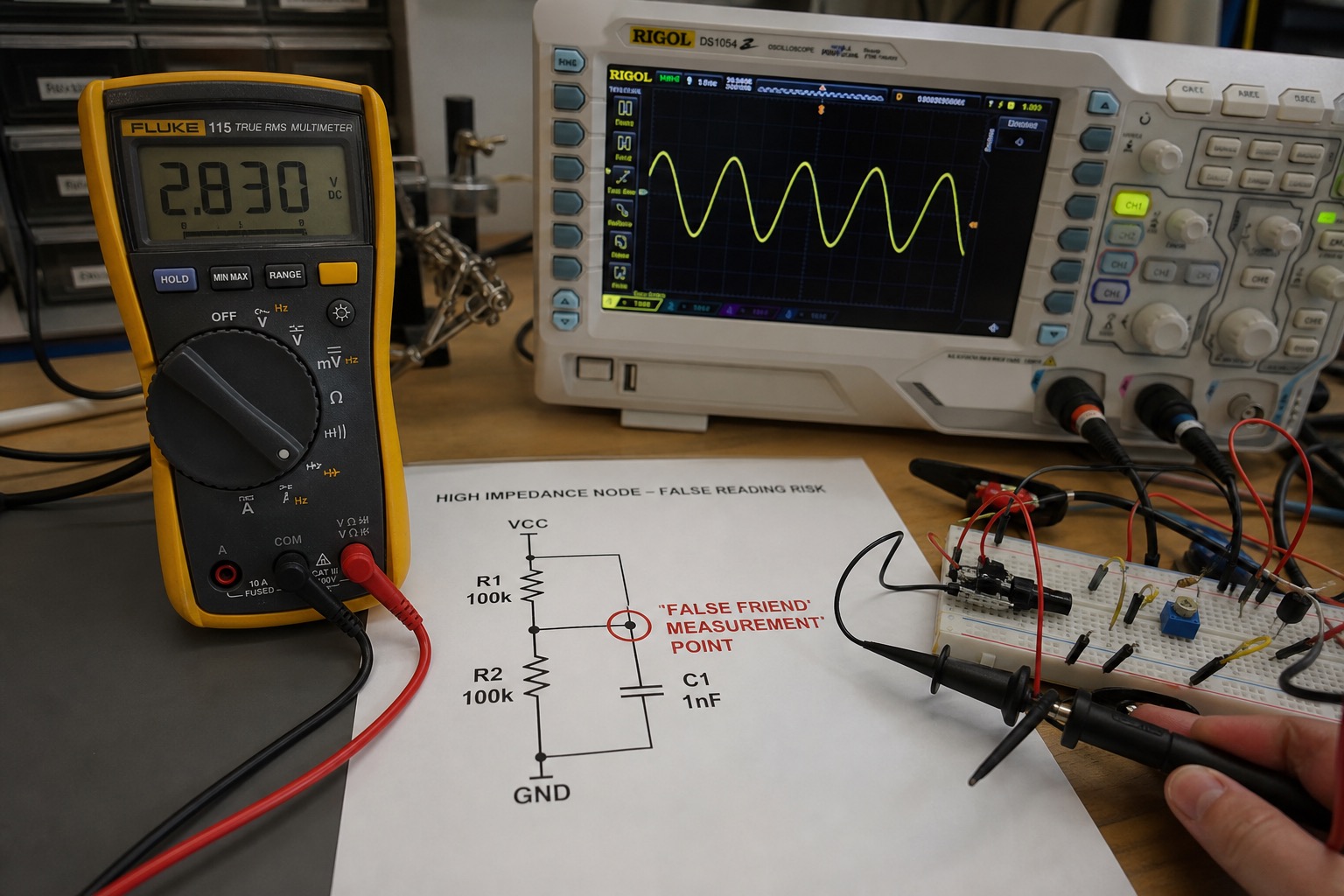
Multimeters measure what their mode assumes — not what you think you are probing. These are readings that looked plausible on a Fluke 117 or Keysight U1232A and sent debug down the wrong path for hours.
1 — AC voltage on a DC rail (coupling lie)
Scene: 3.3 V digital rail "shows 1.2 V AC" on DMM AC range.
Truth: Cheap DMM AC mode is AC-coupled, often high-pass filtered around 5–50 Hz depending on meter. Switching noise, buck ripple, or probe pickup rectifies into a non-zero RMS reading.
Fix: Scope with 20 MHz BW limit for ripple quantification. DMM DC mode for average. Specify frequency if you must use DMM AC — many meters spec 50–400 Hz accuracy only.
2 — Resistance of a powered node
Scene: 10 kΩ pull-up reads 2 kΩ in-circuit.
Truth: DMM resistance mode sources small test current through every parallel path — other resistors, PN junctions, regulator feedback networks.
Fix: Lift one leg, measure out of circuit, or power off and confirm no back-feed from USB debugger. For low values, use 4-wire bench DMM.
3 — Diode test on a MOSFET
Scene: DMM diode beep on drain-source shows "0.4 V" — "FET looks fine."
Truth: Body diode conducts like a diode. Shortened gate, damaged oxide, or ESD may not show in simple junction test. N-channel vs P-channel orientation matters.
Fix: Capacitance compare (if meter has it) between known-good part. Scope: gate charge curve. Never trust diode mode as sole FET qual.
4 — Capacitor ESR via "quick ohm check"
Scene: 100 µF bulk reads 0.8 Ω — "good enough."
Truth: DMM resistance mode uses DC — electrolytic looks like open or high R until charged; reading is meaningless for ESR.
Fix: ESR meter at 100 kHz, or scope: apply step load, measure ΔV/ΔI. Thermal can spot bad cap heating — see thermal camera debugging.
5 — Continuity through a ferrite bead / inductor
Scene: No beep — "open inductor."
Truth: Many DMM continuity thresholds stop at 20–50 Ω. Bead is supposed to be low DC R but not zero; fine wire may exceed beep threshold.
Fix: Read ohms explicitly. Compare to datasheet DC resistance (often 10–500 mΩ).
6 — Phantom voltage on floating cable
Scene: Disconnected UART cable reads 1.8 V.
Truth: Capacitive coupling from adjacent switching traces — high impedance, microamps only. Loads to zero when connected.
Fix: Terminate and measure under load (1 kΩ bleed). Scope input impedance 1 MΩ vs 50 Ω changes story.
7 — Ground reference ambiguity
Scene: "Ground is 0 V" at two points — 80 mV between them.
Truth: Return current through plane resistance (IR drop). DMM on mV range sees real potential difference — not "meter error."
Fix: Measure differential at load pins. Star ground debug for bring-up if needed.
Meter-specific traps
| Meter feature | Trap |
|---|---|
| Auto-ranging | Slow on noisy signal — appears to hunt |
| Min/max hold | Captures spike, not steady state |
| True-RMS | Only accurate within rated crest factor |
| Low-Z AC mode (Fluke LoZ) | Good for ghost voltage elimination — use it |
Our bench default for power rails: DC volts first, scope second, DMM AC never for sign-off.
Real incident — ghost voltage on CAN bus
CAN H/L pair measured 2.1 V differential with DMM on a disconnected harness — tech replaced transceiver unnecessarily. Scope showed 50 mV real swing when terminated with 120 Ω at ECU. Capacitive pickup from adjacent 24 V relay cable run in same conduit.
Lesson posted on bench: always terminate the bus under test before trusting DC voltage on differential pairs.
Meter maintenance and trust
We tag meters with last calibration date. A Fluke 117 off by 40 mV on 1.8 V logic after drop — caught during quarterly check against voltage reference. Cheap meters drift faster; budget calibration or replacement every 3 years on primary benches.
Real incident — "good" 3.3 V during brownout
Bulk cap failing open: DMM showed 3.25 V DC at light load. Under Wi-Fi transmit burst, scope showed dips to 2.7 V for 400 µs — below MCU minimum. DMM too slow; thermal showed cap package cool (open), neighboring LDO hot.
When to escalate to scope / LA
- Any switching supply above 100 kHz
- Serial timing — logic analyzer shootout for protocol; scope for analog front-end
- USB eye diagram — DMM useless
Oscilloscope trigger setup for intermittent rails: trigger cheat sheet.
What I'd do next
Laminate "modes lie" card at each bench: 6 scenarios with red X. Sounds silly; saved junior engineer from shipping Tier 2 wrong LDO based on AC reading last month.
Add DMM AC measurement to forbidden list in hardware test procedure for DC-only nets — QA audit item.
Calibrate meters annually — drift in mV range matters on 1.8 V logic; we use Fluke 5522A service every 12 months on primary bench meters.

Manish Bookreader
Electronics enthusiast, Embedded Systems Expert, Linux/Networking programmer, and Software Engineer passionate about AI, electronics, books, and cooking.